
Project Description
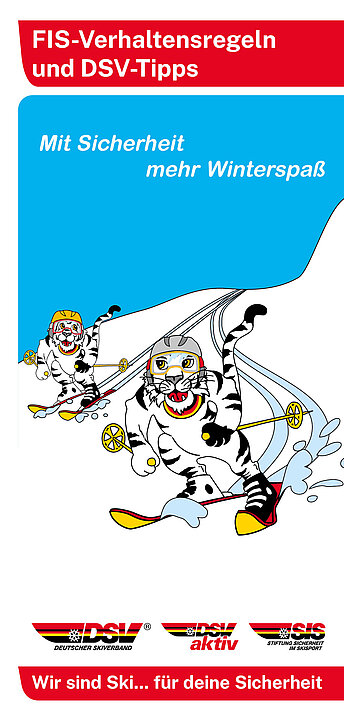
The Foundation for Safety in Skiing promotes concrete measures to improve safety in winter sports. Together with the FIS, DSV aktiv, and the DSV, guidelines for respectful and safe behavior have been developed. By behaving appropriately before and during winter sports, you’ll make friends and help prevent accidents and disputes. Tips on how to safely prepare for and plan a winter sports activity contribute to a successful experience. The FIS rules of conduct for the slopes, cross-country trails, and environmental stewardship can also be found on-site in the resorts.
Objective
Clear and consistent rules are intended to prevent disputes and accidents in winter sports. The behavior of a group is noticed more clearly than that of an individual. Polite, courteous, and cooperative behavior toward other winter sports enthusiasts usually earns a friendly smile and opens many doors. A responsible and respectful attitude toward people and the environment is the foundation for a positive winter sports experience for everyone.
FIS Code of Conduct
Be careful and considerate of others and your fellow skiers and snowboarders
1. Be considerate of other skiers and snowboarders
Every skier and snowboarder must behave in such a way as not to endanger or injure others.
2. Controlling Speed and Maneuvering
Every skier and snowboarder must ski or snowboard within their field of vision. They must adjust their speed and manner of skiing or snowboarding to their ability and to the terrain, snow, and weather conditions, as well as to the density of traffic.
3. Choice of Lane
Skiers and snowboarders approaching from behind must choose their course so as not to endanger skiers and snowboarders ahead of them.
4. Passing
Overtaking may be done from above or below, from the right or from the left, but always at a distance that allows the skier or snowboarder being overtaken sufficient room for all their movements.
5. Entering the Slope, Starting Off, and Traveling Uphill
Any skier or snowboarder entering a ski run, setting off again after stopping, or intending to turn or ride uphill must look both up and down the slope to ensure that they can do so without endangering themselves or others.
6. Stopping
Every skier and snowboarder must avoid lingering unnecessarily in narrow or blind spots on a run. A skier or snowboarder who has fallen must clear such a spot as quickly as possible.
7. Ascending and Descending
A skier or snowboarder ascending or descending on foot must use the edge of the run.
8. Observing Signs
Every skier and snowboarder must observe the markings and signage.
9. Providing Assistance
In the event of an accident, every skier and snowboarder is obligated to provide assistance.
10. Obligation to Provide Identification
Every skier and snowboarder—whether a witness or a party involved, whether responsible or not—must provide their personal information in the event of an accident.
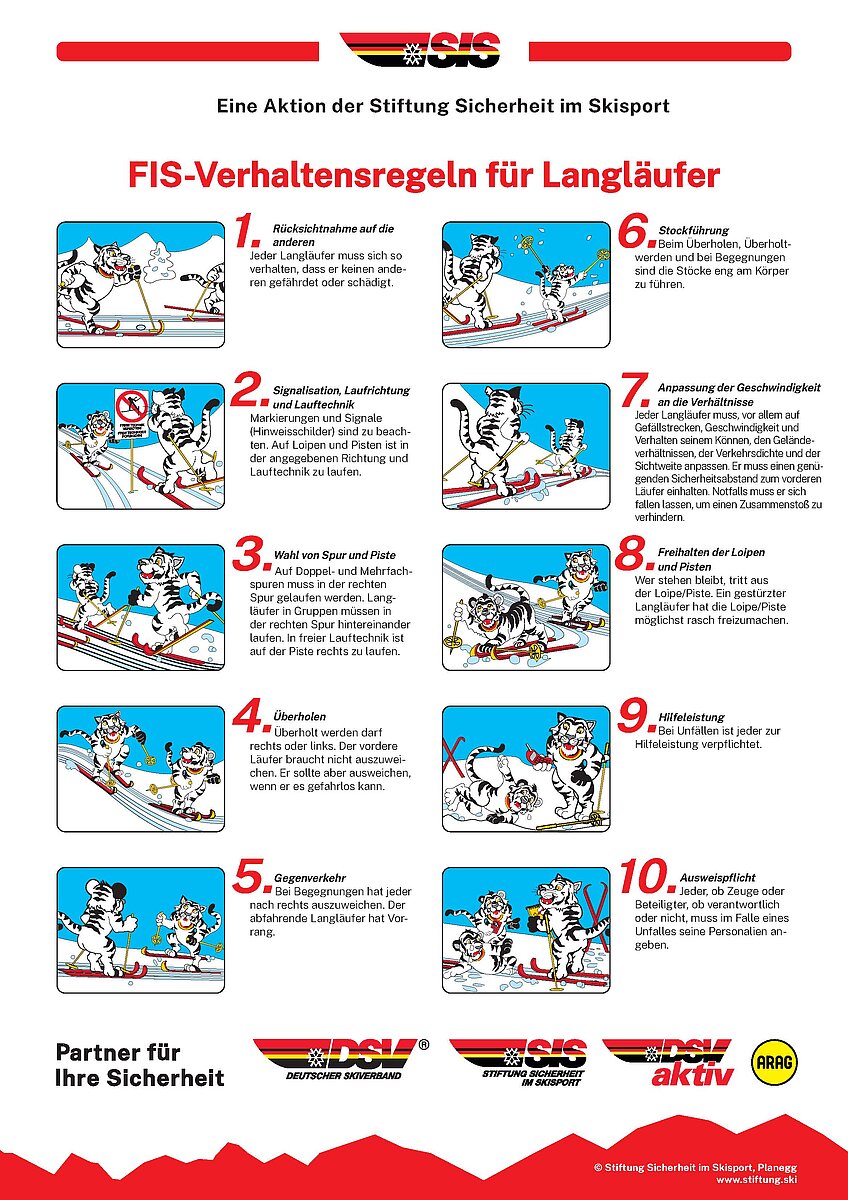
Consideration for Others, Choosing a Track and Direction of Travel, and Other Rules for Cross-Country Skiers
1. Consideration for Others
Every cross-country skier must behave in such a way as not to endanger or harm others.
2. Signage, Direction of Travel, and Skiing Technique
Markings and signs must be observed. On trails and slopes, skiers must follow the indicated direction and use the specified skiing technique.
3. Choice of Lane and Trail
On double or multiple tracks, skiers must use the right-hand track. Cross-country skiers in groups must ski in single file in the right-hand track. When using the free technique, skiers must ski on the right side of the trail.
4. Overtaking
Overtaking is permitted on the right or left. The skier in front is not required to yield. However, they should yield if they can do so safely.
5. Oncoming Traffic
When encountering oncoming skiers, everyone must yield to the right. The skier descending has the right of way.
6. Pole Handling
When passing, being passed, or encountering another skier, poles must be held close to the body.
7. Adjusting Speed to Conditions
Every cross-country skier must, especially on downhill sections, adjust their speed and behavior to their skill level, the terrain conditions, the volume of traffic, and visibility. They must maintain a sufficient safety distance from the skier ahead. If necessary, they must slow down to prevent a collision.
8. Keeping the trails clear
Anyone who stops must step off the trail. A cross-country skier who has fallen must clear the trail as quickly as possible.
9. Providing Assistance
In the event of an accident, everyone is obligated to provide assistance.
10. Obligation to Provide Identification
Everyone—whether a witness or a participant, whether responsible or not—must provide their personal information in the event of an accident.
(ORDER POSTER BUTTON)
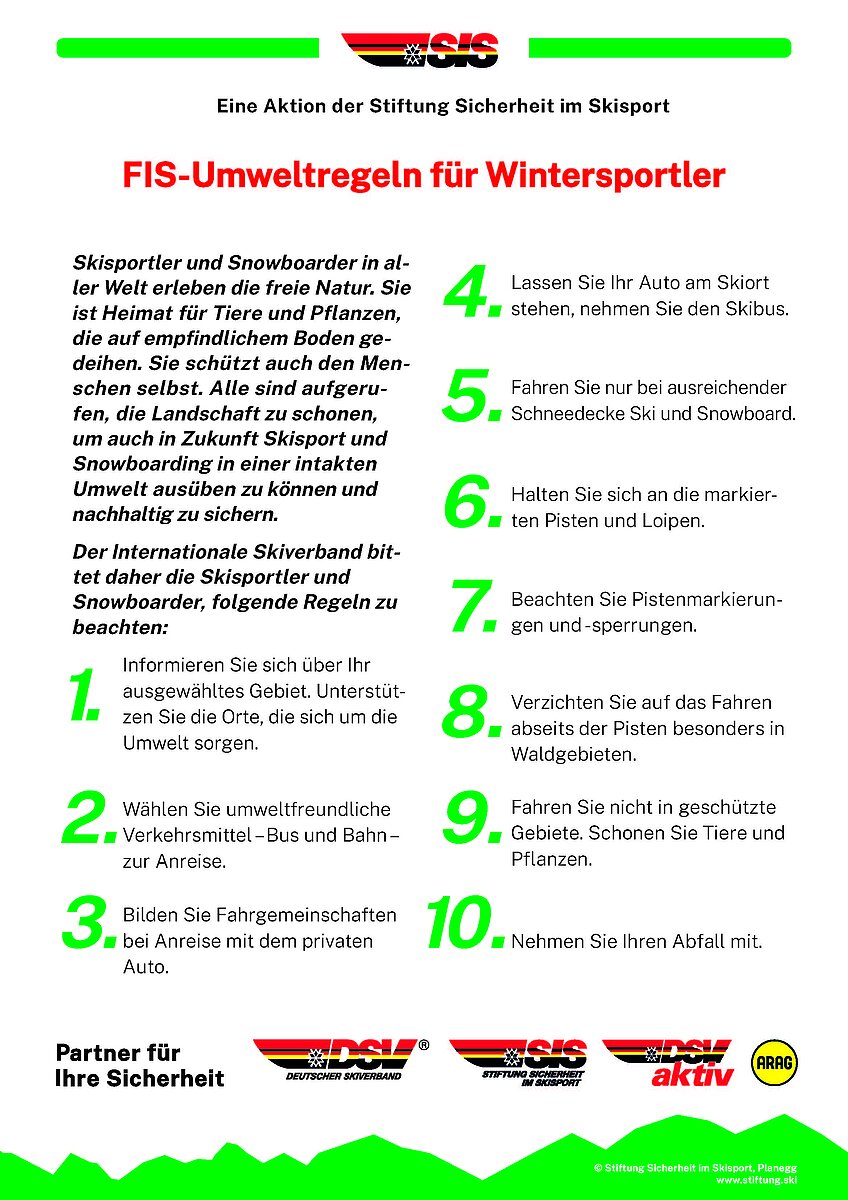
To ensure a healthy environment for future generations of winter sports enthusiasts
Skiers and snowboarders around the world enjoy the great outdoors. It is home to animals and plants that thrive on sensitive terrain. It also protects people themselves. Everyone is called upon to respect the landscape so that skiing and snowboarding can continue to be enjoyed in an intact environment in the future and be sustainably preserved.
The International Ski Federation therefore asks skiers and snowboarders to observe the following rules:
- Learn about the area you’ve chosen.
Support destinations that care about the environment. - Choose eco-friendly modes
of transportation, such as buses and trains, for your trip. - Carpool if traveling by private car.
- Leave your car at the ski resort and take the ski bus.
- Only ski or snowboard when there is sufficient snow cover.
- Stick to the marked slopes and cross-country trails.
- Pay attention to slope markings and closures.
- Avoid skiing or snowboarding off-piste
, especially in forested areas. - Do not enter protected areas. Respect wildlife and plants.
- Take your trash with you.
DSV Tips
Proper behavior is the best protection against accidents, injuries, or illnesses.
Injuries, accidents, or illnesses are not typical consequences of skiing; rather, they are independent of the sport itself. Instead, they are the result of proper or improper behavior on the part of individual skiers. Skiers are in control of their own safety. Proper behavior is the best protection against accidents, injuries, or illnesses. It can be learned.
The 10 DSV Health Rules for Skiers:
- Every skier should be in good physical condition, with the musculoskeletal and cardiovascular systems trained—ideally year-round—to meet all athletic and physical demands.
- Clothing appropriate for the weather conditions is essential to prevent hypothermia. Technical equipment, especially boots and bindings, must comply with the latest safety regulations.
- Take breaks after long runs and avoid skiing for too long, especially during the first few days. Accidents occur most frequently when skiers are fatigued and in the late afternoon.
- If you experience chest pain, dizziness, shortness of breath, or other symptoms, stop immediately and see a doctor as soon as possible.
- Careful and cautious skiing prevents accidents. Never ski through avalanche-restricted areas.
- Avoid eating excessive amounts immediately before or while skiing. Small, carbohydrate-rich snacks have proven effective.
- Do not drink alcohol before or while skiing.
- People with risk factors such as high blood pressure, diabetes, heart problems, or those taking medication, as well as overweight children and adolescents, are usually able to ski but should consult their doctor before doing so.
- It is not age, but rather poor physical condition and health that are reasons to refrain from skiing.
- Skiers should ensure they get enough sleep so that their bodies can recover from the daily physical demands.
For the safety of all ski slope users and a smooth ride on the lift
1. Waiting in Line
Please line up in an orderly fashion and do not cut in line. For platter lifts, ride one at a time; for double-bar lifts, ride in pairs to avoid unnecessary wait times. Snowboarders should step out of the rear binding. Only on lifts without an attendant should you grab the platter or bar yourself.
2. Boarding
Hold your poles in your outer hand and step quickly toward the boarding area. Turn inward and reach for the tow bar with your free hand.
3. Setting off
Do not sit on the bar! Stand upright, lean slightly against the bar, and let yourself be pulled along. Snowboarders should place their free foot between the bindings.
4. While riding
Maintain your balance. If using a double tow bar, do not lean outward or toward your fellow rider.
5. Don’t take risks
Stay on the lift track and do not slalom. Never get off early—this endangers yourself and others.
6. What to Do After a Fall
If you fall, make every effort to clear the lift line immediately. People behind you often cannot avoid you.
7. Before getting off
Prepare to get off the lift in good time. Make sure the tow bar doesn’t get caught in your clothing.
8. Exiting
Exit quickly on the designated side. Release the bar in the direction of travel. Throwing it aside endangers others.
9. Leaving the exit area
Immediately leave the entire exit area to make room for those behind you. Anyone lingering here could also be struck by a swinging bar.
(NOTE: ON THE OLD PAGE, EACH SECTION INCLUDES IMAGES > IF NECESSARY, UPLOAD THEM HERE AS A PDF FOR VIEWING)
For the safety of all slope users and a smooth chairlift ride
1. Waiting in line
Please line up in an orderly fashion and do not push or shove. Observe the minimum height requirements for children. Do not leave any boarding spots empty to avoid unnecessary wait times. Snowboarders should step out of the rear binding.
2. Boarding
Move quickly toward the conveyor belt or boarding area and hold your poles in one hand. Look behind you and watch for the approaching chair. After sitting down, close the safety bar, being considerate of your seatmate. Place your skis on the rack and hold them steady to prevent the bindings from accidentally opening.
3. During the ride
Please sit still, keep your skis pointing in the direction of travel, and do not rock back and forth. Ride all the way to the exit. Anyone who gets off early endangers themselves and others. Throwing objects down the slope and smoking are strictly prohibited for safety and environmental reasons.
4. Interruption of the Ride
Even during a prolonged interruption of the ride, remain calm and reassure your seatmate. Always wait for instructions; never act on your own initiative. Jumping off the chairlift is life-threatening because the perceived distance to the ground is always misleading.
5. Before Exiting
Prepare to exit well in advance. Do not open the safety bar until you reach the sign, and lift your ski tips before arriving at the exit.
6. Exiting
Exit on the designated side and immediately leave the entire exit area. Anyone who lingers here endangers those behind them and themselves.
Safety Precautions When Snowcats Are in the Area
1. Personal Responsibility of Skiers and Snowboarders
You should always expect snowcats to be in operation, even during regular skiing hours. When choosing a route, skiers should always keep in mind that these machines often travel uphill, are difficult to maneuver, and that the operator may not always have a full view of the surrounding terrain.
2. Keep Your Distance
Skiers must never get too close to a snow groomer, whether it is moving or stationary. They must always be prepared for the possibility that it may suddenly change direction, stop, or reverse. Therefore, the safety distance must not be less than 15 meters to the front and rear, and 3 meters to the sides.
3. Do Not Ride Behind
The maneuvers of snow groomers are unpredictable. Following too closely is life-threatening!
4. Sometimes Out of Sight
Snow groomers must also work in areas with limited visibility or in narrow passages. In doing so, they often travel uphill. You must always be prepared for them to appear suddenly. For your own safety, you must therefore always drive within sight of the snow groomer and avoid sudden changes in terrain.
5. Right of Way for Snowcats
Always yield the right of way to snow groomers and let them pass first. If in doubt, ski trail users must stop at a safe distance until the machine has passed. This applies especially in narrow sections.
6. Risk of Slipping on Steep Slopes
On steeper slopes, the snow groomer may start to slide. Skiers and snowboarders below should therefore watch it closely, maintain a wide berth, and leave its work area as quickly as possible. Never cross above a snow groomer on a steep slope. If you fall, there is a risk of sliding into the machine.
7. Make Your Presence Known
If a skier or snowboarder cannot get out of the way (due to a fall, equipment failure, etc.), they must make their presence known to the operator by using the clearest possible signals. If necessary, other skiers or snowboarders should warn the operator.
8. Danger After the Slopes Close or When Slopes Are Closed
After the slopes close or when they are closed, grooming operations take place during which the machines are often anchored to steel cables over 1,000 meters long. Because the cable is often invisible or can suddenly shoot upward, there is a risk of death!
Winter Sports Tips
Adequate strength, endurance, and a healthy cardiovascular system form the foundation.
Training Strength, Endurance, and Balance
To prepare physically for winter sports, you should train your strength and basic endurance; in particular, strengthening the muscles of the ankles, thighs, and core is important.
A strong cardiovascular system and good balance make it easier to participate in winter sports.
Acclimatization Phase
Upon arrival at the winter sports resort, it’s a good idea to allow time for your cardiovascular system to adjust to the mountain air and altitude. Acclimatization activities—such as a hike through the town—help you get used to the altitude and also help you get your bearings in the area.
Warm-up
It’s also important to start each day of winter sports with an acclimatization phase or a daily warm-up before engaging in winter sports. During this time, you should avoid large changes in elevation caused by rapid ascents and descents. When skiing, difficult slopes and long, fast descents should also be avoided at the start of the day. Instead, it’s better to “warm up” on easy slopes with a leisurely ride and several breaks. A fall when your body is “cold” usually has painful consequences. Well-known instructional principles, such as “from easy to difficult” or “from the familiar to the unfamiliar,” help with this process.
Avoid Overwhelming Participants
Differences in fitness levels or athletic abilities among individual group members must be taken into account when organizing activities on-site. To ensure no group member is overwhelmed while participating in winter sports, the “weakest link in the group” should serve as the benchmark, or tasks should be tailored to individual abilities
Take Breaks
Likewise, the “weakest link” in the group determines when to take breaks and rest periods. In such cases, it’s better to take an extra break or end the winter sports activity early. Experience shows that most accidents occur in the afternoon or toward the end of the winter sports session, when participants are exhausted, tired, and unable to concentrate.
Food and Drink
Ensure an adequate energy intake. Only a healthy diet provides strength and the necessary concentration for winter sports. Drinking plenty of fluids is especially important at high altitudes, and eating regularly—spreading several small meals throughout the day—provides the body with the energy it needs. In addition, make sure to get enough sleep, as this provides the strength and focus needed for the next day of winter sports.
Rest Day
“Day three” of a winter sports week should be scheduled as a rest day or structured with a variety of activities. Experience shows that physical stamina and mental alertness tend to decline on the third day.
In addition to the equipment, protective gear, ski goggles, and appropriate clothing are essential.
Winter sports gear that’s tailored to your individual needs (skis, bindings, boots, poles, protective gear such as helmets, pads, ski goggles, gloves, and clothing, etc.) makes a day of winter sports a fun and safe experience. Specialty sports retailers can assist with any technical safety questions regarding your gear.
Get Informed in Advance
An informational evening prior to the winter sports trip on the topic of “Required Equipment and Its Condition” is advisable. Ideally, this should be conducted with the expert guidance of a local sports retailer. Long-term partnerships with such retailers are recommended.
Resolving Problems On Site
If problems with winter sports equipment (damage, defects, malfunctions, etc.) arise during the winter sports trip, visit the specialty sports retailer at the winter sports resort immediately. It is advisable to establish contact with them in advance.
Equipment Suited to Your Skill Level
Winter sports equipment must be individually tailored to the athlete’s skill level. Well-maintained equipment—such as waxed bases and sharpened edges—makes practicing winter sports easier, conserves energy, facilitates concentration, and thus helps prevent injuries. The equipment should be checked and serviced by a specialty sports retailer at regular intervals (depending on usage)—ideally right at the start of the winter season or before your winter vacation.
Equipment Check
It is recommended to have your winter sports equipment inspected by a specialty sports retailer at the start of each winter season. Defective or damaged winter sports equipment should be taken out of service or replaced by the specialty sports retailer.
Ski Bindings
Alpine ski bindings must be properly adjusted to suit the skier’s individual skill level. An annual safety check by a specialty sports retailer—particularly an inspection of the ski bindings—is highly recommended for safety reasons.
Ski Boots
Alpine ski boots must fit snugly; that is, they must not be too large and must not pinch or cause pain. They must not show any signs of damage or cracks. The buckles must be in good working order. An alpine ski boot should not be more than ten years old. With older boots, there is a risk of the shell cracking due to plasticizers leaching out of the boot’s plastic shell. Sports retailers are happy to assist with this.
Ski Poles
Ski poles must not be bent or defective (pole baskets, wrist straps, etc.) and must be individually fitted. A specialty sports store is your first point of contact here.
Ski Helmets
Alpine ski helmets must fit snugly to provide protection in the event of a fall and are required by law. According to the manufacturer, the protective function of an alpine ski helmet expires after eight years (the date of manufacture is printed on the inside of the shell in the insulation material) or after a severe fall (resulting in severe headaches). If you have any questions or are unsure, it’s a good idea to contact a specialty sports retailer.
Ski Goggles
Ski goggles with UV protection should be scratch-free. This is the only way to see clearly during an alpine descent (even in bad weather) and to spot potential hazards. Ski goggles also protect the eyes from increased UV radiation in the mountains.
Other
- Back protectors are recommended for alpine skiing
- Sunglasses with UV protection
- UV skin protection/sunscreen with a high SPF; sunscreen also protects against the cold when applied instead of moisturizer.
- Personal protective equipment: warm, weather-resistant clothing, warm technical base layers, gloves, warm socks, sturdy footwear, etc. (preferably two sets so you can change if they get wet).
- Ski clothing: Dress in layers so you can adjust to the weather (weather-resistant outer layer, insulating middle layer, moisture-wicking base layer next to the skin).
The choice of ski resort is crucial when it comes to safety.
The success of a winter sports trip depends entirely on choosing the right winter sports region or resort. Likewise, selecting the right resort can help minimize many safety risks. It is advisable to collaborate with organizations in the winter sports resort.
Size
Small, manageable winter sports venues and ski resorts are usually less crowded.
Difficulty Level
The selection of the winter sports region or area is primarily based on the participants’ skill level (orient toward the “weakest link in the chain”). When selecting a ski resort, take into account the difficulty level (blue, red, black) of the slopes. If necessary, a suitable, fenced-off practice area should be available.
Lift Systems
Take the lift systems (chairlifts, T-bar lifts, gondolas) into account when selecting a ski resort.
Alternative (Sports) Activities
Winter sports resorts should offer a suitable supporting program or alternative sports options in case of bad weather (indoor pool, ice rink, movie theater, etc.).
Certifications
DSV/SIS-certified ski resorts should be preferred. SIS-certified rental shops and hotels should be preferred.
Location of Accommodations
Short distances from the lodging to the winter sports facility make planning easier.
On-site
Panoramic maps and trail maps make it easier to find your way around and are available in most ski resorts. It is recommended to contact the local ski school, mountain school, or mountain rescue service. Keep an eye on the daily avalanche report and the avalanche warning lights on the panoramic maps at the main ticket offices in the ski resort.
Guidance and tips for organizing a group effectively and safely.
Winter sports groups require good, straightforward organization to ensure that the winter sports day is a success for all participants and instructors alike.
- Adjust the speed based on the situation, taking into account the weakest member of the group.
- Keep a safe distance from other skiers.
- Allow for sufficient breaks and rest periods for all group members, including the last one to arrive.
- Do not set off all at once as a group.
- Take into account specific organizational arrangements for ski groups (skiing individually, in a line, in pairs, etc.).
- Provide precise details about the next meeting point or stop.
- Follow teaching principles: from easy to difficult; from the familiar to the unfamiliar, etc.
Additional information:
The texts presented here, written in simple language, serve as supplementary explanations of the current FIS rules. They do not constitute an official amendment or interpretation of the rules, but are intended to aid in understanding their content. The texts were developed as part of a student thesis at the DSHS Cologne (Kathrin Straub, Master’s program in Special Education):
- FIS Rules of Conduct in Simple Language
- FIS Rules of Conduct for Cross-Country Skiing in Simple Language
- DSV Tips: Rules of Conduct for Snowcats in Simple Language
- DSV Tips: Rules of Conduct for T-Bar Lifts in Simple Language
- DSV Tips: Rules of Conduct for Chairlifts (plain language)
- FIS Environmental Rules in Simple Language
- DSV Health Rules (Simple Language)
- Fun Park Rules (Simple Language)